If you are a member of the media, please email ngarcia@azcc.gov or call (602) 542-0728.
If you are a member of the media, please email ngarcia@azcc.gov or call (602) 542-0728.
Phoenix, Ariz. — The Arizona Corporation Commission is committed to encouraging public participation in the ratemaking process by sharing timely and transparent updates. Understanding the accounting principles and complexities behind ratemaking is also essential to help customers see how rates are calculated.
With that in mind, the Commission would like to provide an update on the Tucson Electric Power Company (TEP) rate case, which is currently about halfway through the overall process.
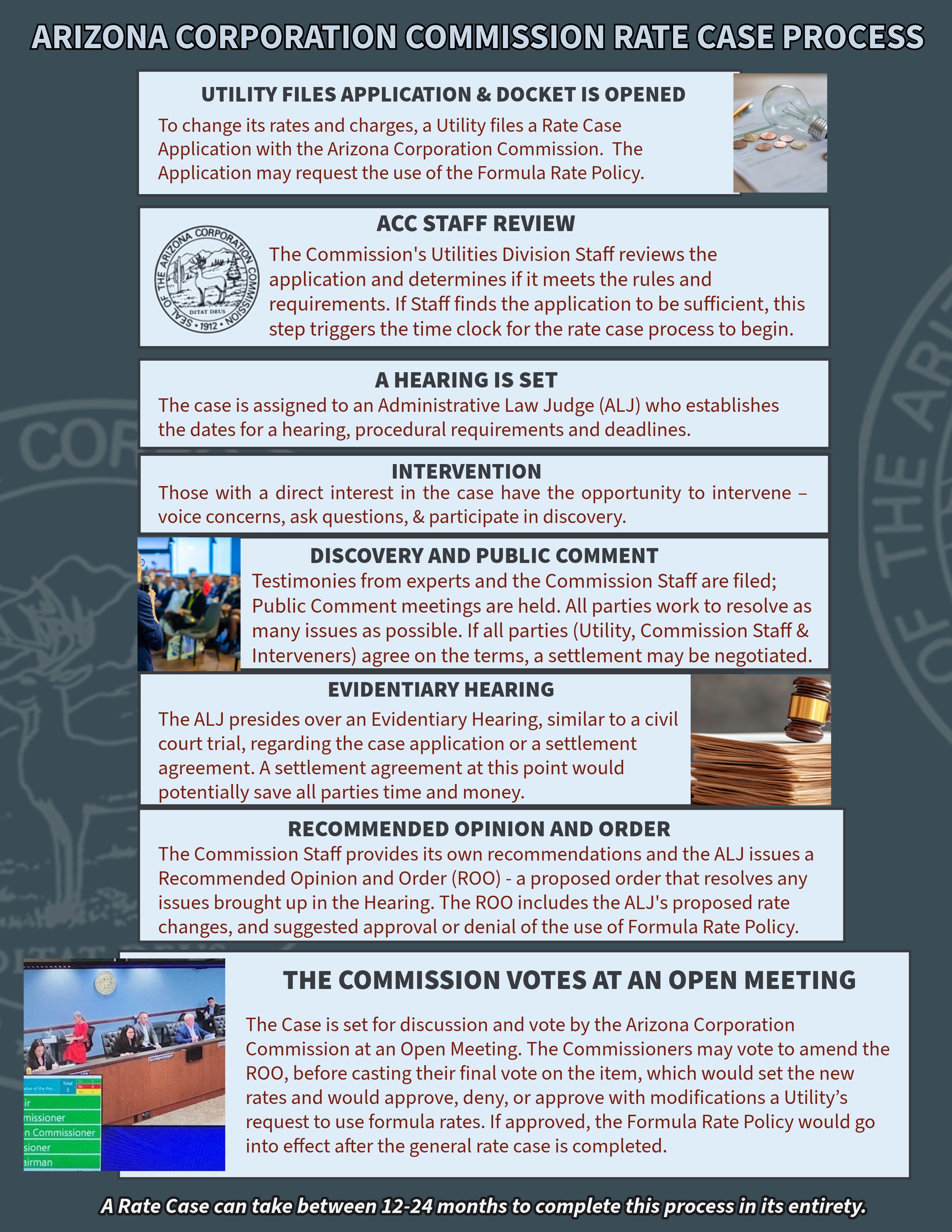
The rate case timeline can be broken down into eight steps::
“The Commission does not adjudicate cases in the media,” said Chair Nick Myers. “There will be a full, and open, and transparent public hearing where all parties, will have the opportunity to present their arguments and evidence. The process allows for a full examination and cross examination of positions.”
At this time, the TEP rate case is in step five of the process. There are approximately a dozen intervenors—parties or organizations with a direct interest in the case. Each intervenor may file any evidence, testimony, or other discovery they intend to rely on to support a proposed rate that differs from TEP’s request. All submitted materials become part of the official record and are available for public review.
Over the next few weeks the ALJ, Staff, and Intervenors will have the opportunity to review the evidence – which totals several thousands of pages. All parties will present their arguments and evidence before the ALJ during the scheduled evidentiary hearing beginning on April 22, 2026, which is expected to last about three weeks.
During this process, ACC Staff performs a comprehensive audit of TEP’s accounting practices and recordkeeping. The outcome of the rate case reflects the combined application of standardized accounting methods, calculations supported by expert testimony, independent forecasting, market data, academic research, and detailed analyses of appropriate utility returns. The core formula used in rate design to determine a utility's revenue requirement is:
Revenue Requirement (R) = Operating Expenses (E) + [Rate Base (Value  - Depreciation) X Rate of Return (r)
The goal of a rate case is to establish just and reasonable rates that allow utilities to recover prudently incurred expenses, earn a reasonable return on their investments, and charge customers only for costs that are determined to be prudent. Customer affordability is certainly taken into account. However, the Commission has a constitutional duty to establish just and reasonable rates based on evidence in the record, and cannot deny recovery of prudent investments in a utility.
“Utilities rarely, if ever, receive all of what they request in their rate case applications,” said Chairman Myers. “The Commission carefully evaluates utility applications and removes unjustified expenses from recovery, while continuing to support prudent investments in grid resilience and expansion. We do not want to add to the significant financial pressures already facing ratepayers. However, the alternative can be far more costly over time—if power becomes unreliable or unavailable, public safety and lives may be at risk.”
One of the constitutional responsibilities of the Commission is to set just reasonable rates; it cannot simply deny a utility’s application on the basis of not wanting to increase rates. The Commission’s regulatory responsibility is to establish just and reasonable rates and to ensure the utility is providing safe and reliable services to its customers.
All documents related to the TEP rate case can be found in the ACC’s eDocket system at https://edocket.azcc.gov/ , Docket No. E-01933A-25-0103.